Michigan's mix of small hobby farms, larger row-crop operations, and rural residential acreage means agricultural fencing here has to do a lot of different jobs. Whether you're keeping goats in, keeping deer out of your orchard, or just marking 20 acres of property line, here's an overview of what actually works in our climate and terrain.
Woven wire (field fence)
The workhorse of Michigan farm fencing. Woven wire uses vertical stays welded to horizontal wires, creating a grid strong enough to hold cattle, horses, sheep, and goats. Standard heights run from 32 to 60 inches.
- Best for: mixed livestock, perimeter fencing on hobby farms.
- Lifespan: 20–30 years with class 3 galvanization.
High-tensile smooth wire
Fewer strands, higher strength, and less material cost per linear foot than woven wire. Excellent for cattle and horses on larger acreage. Requires proper bracing at corners and ends to hold tension through Michigan's freeze-thaw cycle.
Barbed wire
Still common on cattle operations in the Thumb and mid-Michigan. Not appropriate for horses or hobby farms with kids. Michigan doesn't restrict barbed wire on agricultural land, but many local ordinances prohibit it in residential zones, so always check first.
Wood post-and-rail
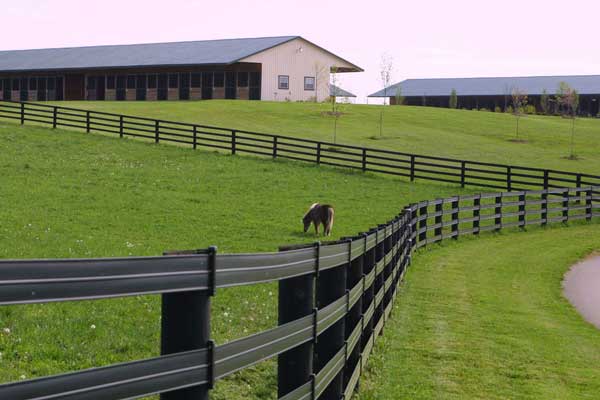
The classic look for horse farms and equestrian properties. Three- or four-board oak or treated pine fencing is beautiful but requires ongoing maintenance and periodic board replacement.
Deer fencing
Michigan's deer population is a real threat to orchards, vineyards, and market gardens. Effective deer fencing typically requires:
- At least 8 feet of height, or
- A slanted 6-foot fence angled outward at roughly 45 degrees.
Woven polypropylene deer netting is cost-effective for orchards; woven wire deer fencing is more durable long-term.
What we don't install: electric fencing
We get asked about electric fencing regularly, and we don't offer it. It requires ongoing testing and adjustment that homeowners are usually better off handling directly with an ag supplier. We focus on permanent physical barriers that don't need a controller and a ground rod to keep working.
Post choice matters more than the wire
In our clay-heavy soils, especially in Monroe and Lenawee counties, the difference between a 20-year fence and a 5-year fence is the posts:
- Pressure-treated wood posts (CCA-treated, not just ACQ): best all-around choice.
- Steel T-posts: fast to install for line posts; not strong enough for corners.
- Concrete or heavy wood braced assemblies: required at every corner, end, and gate.
Setback and property line rules
Michigan's "fence law" (Act 260 of 1917) requires adjoining landowners to share the cost of a division fence between agricultural properties. The rules are more nuanced than most people realize; if you're building a shared boundary fence with a neighbor, it's worth reading up on your county's process for handling disagreements.
Whether you're fencing 2 acres or 200, we're happy to walk your property and put together a written estimate. Prime Fence has installed agricultural fencing across southeast Michigan since 2010; we know the soils, the seasons, and what actually holds up out here.